


This post is sponsored by Nordic Semiconductor.
Not every connected product needs a powerhouse SoC. In fact, a huge portion of Bluetooth Low Energy (Bluetooth LE) devices out there are doing relatively straightforward things — reading a temperature sensor, broadcasting a beacon signal, or forwarding button presses from a remote control. For these kinds of applications, loading up on memory and peripherals you’ll never use just drives up cost and complexity without adding real value.
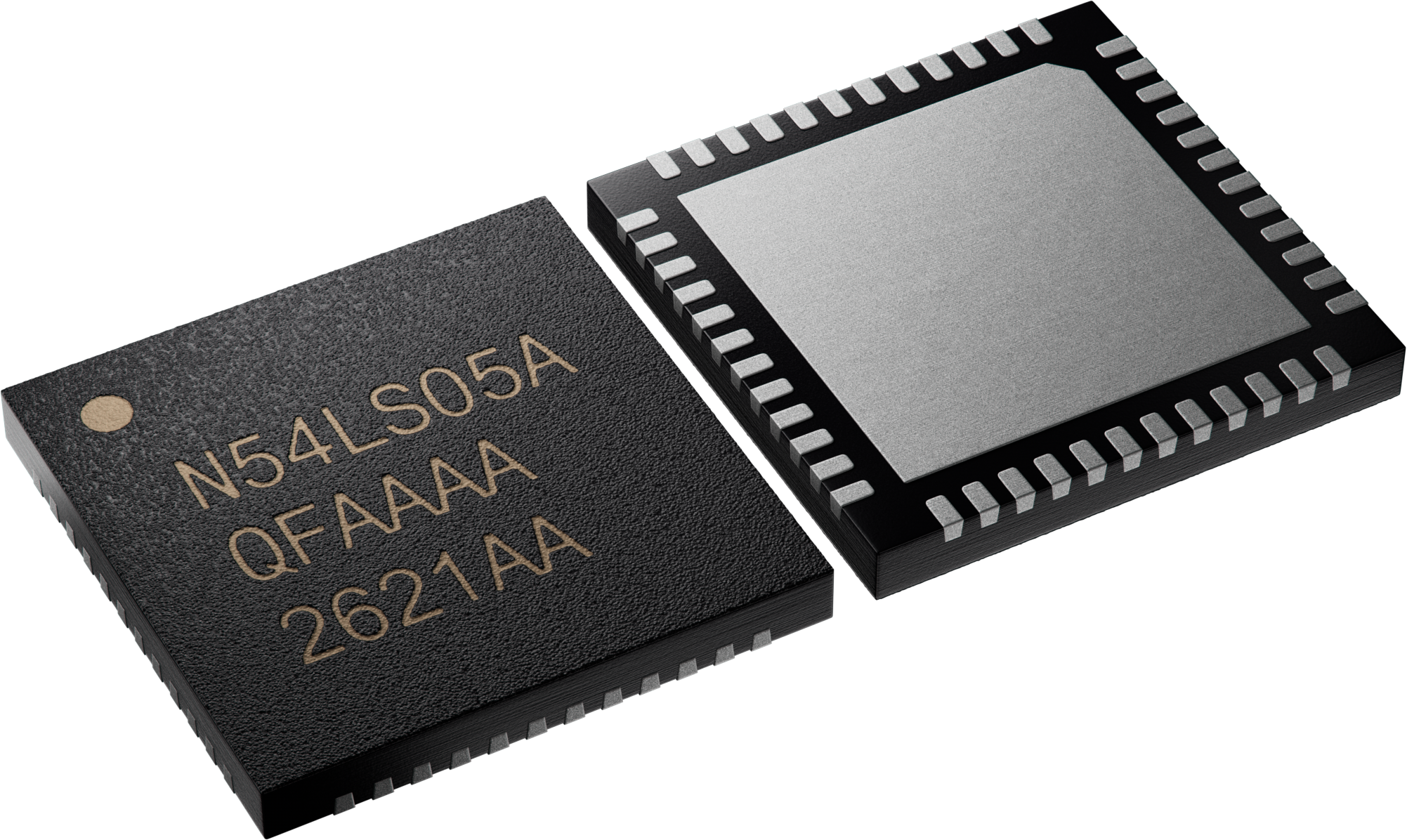
Nordic Semiconductor clearly understands this. After expanding the nRF54L Series with the feature-packed nRF54LM20A (which I covered in a previous post), they’ve now introduced the nRF54LS05A and nRF54LS05B — entry-level, ultra-low-power Bluetooth LE SoCs built specifically for simple, cost-sensitive wireless applications.
Note: The nRF54LS05A/B datasheet is currently preliminary (v0.6), and all specifications listed in this post are estimated values that may change in subsequent updates. Nordic is running a project-based early access program — customers can apply to be enrolled and receive SoC samples and development kits.
Think of them as the “right-sized” members of the nRF54L family. They inherit the same 22nm architecture and power efficiency improvements that define the series, but with a memory and peripheral set that’s specifically sized to keep costs low and design complexity to a minimum.
In this post, we’ll cover:
- Where the nRF54LS05A and nRF54LS05B fit within the nRF54L Series lineup
- The key technical features and specifications of these new SoCs
- The difference between the LS05A and LS05B variants
- Power consumption highlights from the preliminary datasheet
- Real-world applications they’re well suited for
- How nRF Connect SDK Bare Metal simplifies development and migration from the nRF5 SDK
The nRF54L Series: A Complete Portfolio
If you’ve been following Nordic’s product evolution, you’ll know that the nRF54L Series represents a significant step forward from the widely adopted nRF52 generation. Built on a 22nm low-leakage process (compared to the previous-generation process used in the nRF52), the series delivers roughly 2x the processing power and 3x the processing efficiency, with an Arm Cortex-M33 running at 128 MHz. Nordic has stated that these improvements, combined with a ultra-low-power radio, result in an average 30%–50% lower system power consumption for common Bluetooth LE use cases.
But here’s what makes the nRF54L Series particularly interesting from a product planning perspective: it’s not just one chip. It’s a family of SoCs spanning a wide range of capabilities — from entry-level to premium — with aligned pinouts across multiple variants in the series to streamline hardware migration. Let’s take a quick look at how the lineup breaks down:
- nRF54LS05A/B — Entry-level. 508 KB NVM, 64–96 KB RAM. Optimized for cost-sensitive, simple Bluetooth LE applications.
- nRF54L05 — Entry-level tier with 500 KB NVM and 96 KB RAM, but includes a RISC-V coprocessor and a broader peripheral set (I2S, PDM, NFC) compared to the LS05 variants.
- nRF54L10 — Mid-range option with 1 MB NVM and 192 KB RAM.
- nRF54L15 — The established workhorse of the series, with 1.5 MB NVM, 256 KB RAM, and a RISC-V coprocessor.
- nRF54LM20A — The most feature-rich option in the series, with 2 MB NVM, 512 KB RAM, up to 66 GPIOs, high-speed USB, and comprehensive multi-protocol support.
The nRF54LS05A and nRF54LS05B are drop-in pin-to-pin compatible with each other. For migration to other variants in the series (such as the nRF54L05, nRF54L10, or nRF54L15), the pinouts are the same for the overlapping set of features — which streamlines hardware migration, though some board-level changes may be needed depending on the specific features used. For example, the nRF54LS05A/B feature 37 GPIOs on the QFN48 package, while the nRF54L05 features 31 GPIOs on the same package.
That kind of design flexibility is a big deal in product development, especially when you’re managing multiple SKUs or planning for future variants.
Key Highlights: What the nRF54LS05A/B Bring to the Table
Let’s dive into the technical details. Despite being the entry-level option, these SoCs pack a solid set of features for their target applications.
128 MHz Arm Cortex-M33
The nRF54LS05A and nRF54LS05B run the same Arm Cortex-M33 processor at 128 MHz as the rest of the nRF54L Series. This is a meaningful upgrade from the Arm Cortex-M4 in the nRF52 generation — you get improved power efficiency per instruction. Note that unlike the higher-end nRF54L variants, the LS05 does not include DSP or FPU capabilities.
The preliminary datasheet lists a CoreMark score of 500 at 3.90 CoreMark/MHz, which is roughly 2.4x the nRF52840’s score of 212 — meaning significantly more processing headroom while consuming less power per operation (2.0 mA during CoreMark execution from RRAM with cache).
Note that while the Cortex-M33 architecture supports TrustZone, it is not available on the nRF54LS05 variants due to memory constraints.
Even for “simple” applications, having a capable processor means your firmware runs faster and returns to sleep sooner, which directly translates to longer battery life.
Right-Sized Memory
Both variants come with 508 KB of Non-Volatile Memory (NVM), which is plenty for a Bluetooth LE application stack plus your application firmware. Where they differ is in RAM:
- nRF54LS05A: 508 KB NVM + 64 KB RAM
- nRF54LS05B: 508 KB NVM + 96 KB RAM
For context, these memory sizes are comparable to the popular nRF52832 (512 KB Flash, 64 KB RAM), making the LS05 a natural upgrade path for many existing nRF52-based designs.
64 KB of RAM is sufficient for many straightforward Bluetooth LE applications — a sensor that advertises data, a beacon, or a simple peripheral. The 96 KB option (nRF54LS05B) gives you extra headroom if your application needs to handle more simultaneous connections, larger data buffers, or more complex protocol handling.
I’d recommend the nRF54LS05B if you’re not tightly cost-constrained and want a comfortable margin for firmware growth. Either way, both variants should serve most simple Bluetooth LE applications well.
2.4 GHz Radio
The nRF54LS05A/B feature Nordic’s ultra-low-power 2.4 GHz radio supporting both Bluetooth LE (LE 1M and LE 2M) and proprietary 2.4 GHz GFSK modes at data rates up to 4 Mbps. TX power is configurable from -10 dBm to +4 dBm in 1 dBm steps, with an RX sensitivity of -96 dBm at 1 Mbps Bluetooth LE.
However, unlike the higher-end nRF54L Series SoCs, the LS05 variants don’t support 802.15.4-based protocols — so no Thread, Zigbee, or Matter. For the cost-optimized applications these chips target, the Bluetooth LE and proprietary 2.4 GHz combination covers the vast majority of use cases.
One thing to note: the nRF54LS05 also does not support Bluetooth Channel Sounding. If your application requires high-accuracy distance measurement via Channel Sounding, you’ll want to look at the nRF54L05 or higher.
Essential Peripherals
The nRF54LS05A/B include the peripherals you’d expect for their target applications:
- Three serial interfaces (SPI, TWI/I2C, UART) — enough for communicating with external sensors, displays, or host MCUs. SPI runs up to 8 MHz, TWI up to 400 kHz (I2C compatible), and UART up to 1 Mbps.
- SAADC (Successive Approximation ADC) — four channels with up to 14-bit resolution (oversampled at 31.25 ksps), 12-bit at 125 ksps, or 10-bit at up to 1 Msps. More than sufficient for reading analog sensor data directly.
- PWM (Pulse Width Modulation) — a four-channel modulator with autonomous waveform generation, useful for controlling LEDs, motor speed, or generating audio tones
- QDEC (Quadrature Decoder) — handy for rotary encoder inputs on remote controls or user interfaces
- Global RTC (Real-Time Counter) — notably available even in System OFF mode, which is important for timed wakeups with minimal power draw
- Three 32-bit timers with counter mode, a watchdog timer, and a built-in temperature sensor round out the peripheral set
This is what I’d call a “no-waste” peripheral set. You get what you need for the target applications without paying for extras you won’t use.
Baseline Security
The nRF54LS05A/B include a baseline security configuration designed to support compliance with existing and upcoming regulations for Bluetooth LE products. Specifically, the datasheet lists:
- Secure boot — ensuring only authenticated firmware runs on the device
- Tamper detectors (TAMPC) — physical protection against hardware-level attacks
- Hardware-accelerated Bluetooth LE encryption — a 128-bit AES/ECB/CCM/AAR coprocessor handles cryptographic operations without burdening the CPU
As connected device regulations continue to tighten globally (the EU Cyber Resilience Act, for example), having built-in security features — even at the entry level — is increasingly important.
For example, if you’re building a sensor that receives over-the-air firmware updates, secure boot ensures that only authenticated images can run on the device. This gives you a foundation for secure firmware updates and other security requirements without needing to implement everything from scratch.
Pin-to-Pin Compatibility
The nRF54LS05A/B are available in a QFN48 (6x6 mm) package with 37 GPIO pins. As mentioned earlier, the nRF54LS05A and nRF54LS05B are drop-in pin-to-pin compatible with each other. For migration to other nRF54L Series variants, the pinouts are aligned for the overlapping set of features, which simplifies hardware migration — though some board-level adjustments may be needed depending on the target SoC and features used.
LS05A vs. LS05B: Which One Should You Choose?
Let’s keep this simple, because the difference really is straightforward. Both chips are identical except for the amount of RAM:
| Feature | nRF54LS05A | nRF54LS05B |
|---|---|---|
| Processor | Arm Cortex-M33 @ 128 MHz | Arm Cortex-M33 @ 128 MHz |
| NVM | 508 KB | 508 KB |
| RAM | 64 KB | 96 KB |
| Radio | Bluetooth LE + proprietary 2.4 GHz | Bluetooth LE + proprietary 2.4 GHz |
| Peripherals | SPI, TWI, UART, ADC, PWM, QDEC, GRTC | SPI, TWI, UART, ADC, PWM, QDEC, GRTC |
| Security | Baseline | Baseline |
When does the extra 32 KB of RAM matter? Here are a few scenarios where the nRF54LS05B makes more sense:
- You’re running the Bluetooth LE stack with multiple simultaneous connections
- Your application involves larger data buffers (for example, buffering sensor data before transmitting)
- You want extra headroom for future firmware features without worrying about running out of RAM
- You’re processing data locally before transmitting (filtering, averaging, simple algorithms)
For the simplest use cases — a beacon, a basic sensor, or a remote with a handful of buttons — the nRF54LS05A with 64 KB RAM should be more than enough.
Power Efficiency: The Numbers
Let’s look at the preliminary power consumption figures from Nordic’s datasheet. The nRF54LS05A/B operate on a 1.7–3.6V supply with a single-inductor DC/DC converter, and the operating temperature range is -40°C to +85°C. These are estimated values at 3.0V:
Active with Radio
| Mode | Current (Estimated) |
|---|---|
| Bluetooth LE TX, 1 Mbps at 0 dBm | 4.8 mA |
| Bluetooth LE TX, 1 Mbps at +4 dBm | 6.6 mA |
| Bluetooth LE RX, 1 Mbps | 3.4 mA |
Active with Processing
| Mode | Current (Estimated) |
|---|---|
| CPU CoreMark from RRAM with cache | 2.0 mA |
Sleep Modes
| Mode | Current (Estimated) |
|---|---|
| System ON IDLE with GRTC (XOSC) and 96 KB RAM | 1.2 µA |
| System OFF with GRTC wakeup | 0.7 µA |
| System OFF | 0.6 µA |
The sleep numbers are where things get really interesting for battery-powered devices. At 0.6 µA in System OFF, a standard CR2032 coin cell battery (with roughly 220 mAh of capacity) could keep the device in deep sleep for over 40 years — obviously, the practical limit is the battery’s own shelf life.
Even with the Global RTC (GRTC) running for timed wakeups, the current only increases to 0.7 µA. This means you can maintain periodic timekeeping (for example, waking up every 10 seconds to take a sensor reading) with negligible impact on battery life.
Real-World Applications
The nRF54LS05A/B are designed for applications where simplicity, low cost, and long battery life are the primary requirements. Let’s look at some specific use cases:
Environmental Sensors: Temperature, humidity, air quality, and other sensors that periodically wake up, take a reading, advertise or transmit the data over Bluetooth LE, and go back to sleep. The low sleep current (0.6 µA in System OFF) makes these SoCs well suited for years-long battery life on a coin cell.
Asset Tags and Beacons: Bluetooth LE beacons for indoor positioning, asset tracking tags for warehouses, or proximity-based triggers. These applications typically need minimal processing power but demand extremely low power consumption and small physical size.
Remote Controls: Simple wireless remote controls for consumer electronics, smart home devices, or industrial equipment. The QDEC peripheral is particularly useful here for handling rotary encoder inputs.
PC Peripherals: Wireless mice, keyboards, and other input devices where cost and power efficiency are critical. The proprietary 2.4 GHz mode (up to 4 Mbps) is particularly useful here for low-latency communication, while Bluetooth LE can be used for pairing and smartphone connectivity.
Bluetooth Companion Devices: One use case that’s easy to overlook — the nRF54LS05A/B can serve as a Bluetooth companion chip in a larger system. For example, if you have a product built around a more powerful (but non-wireless) MCU, you can add Bluetooth LE connectivity by pairing it with an nRF54LS05 over SPI or UART. This is a cost-effective way to add wireless capability to existing designs without replacing the main processor.
Getting Started: nRF Connect SDK Bare Metal
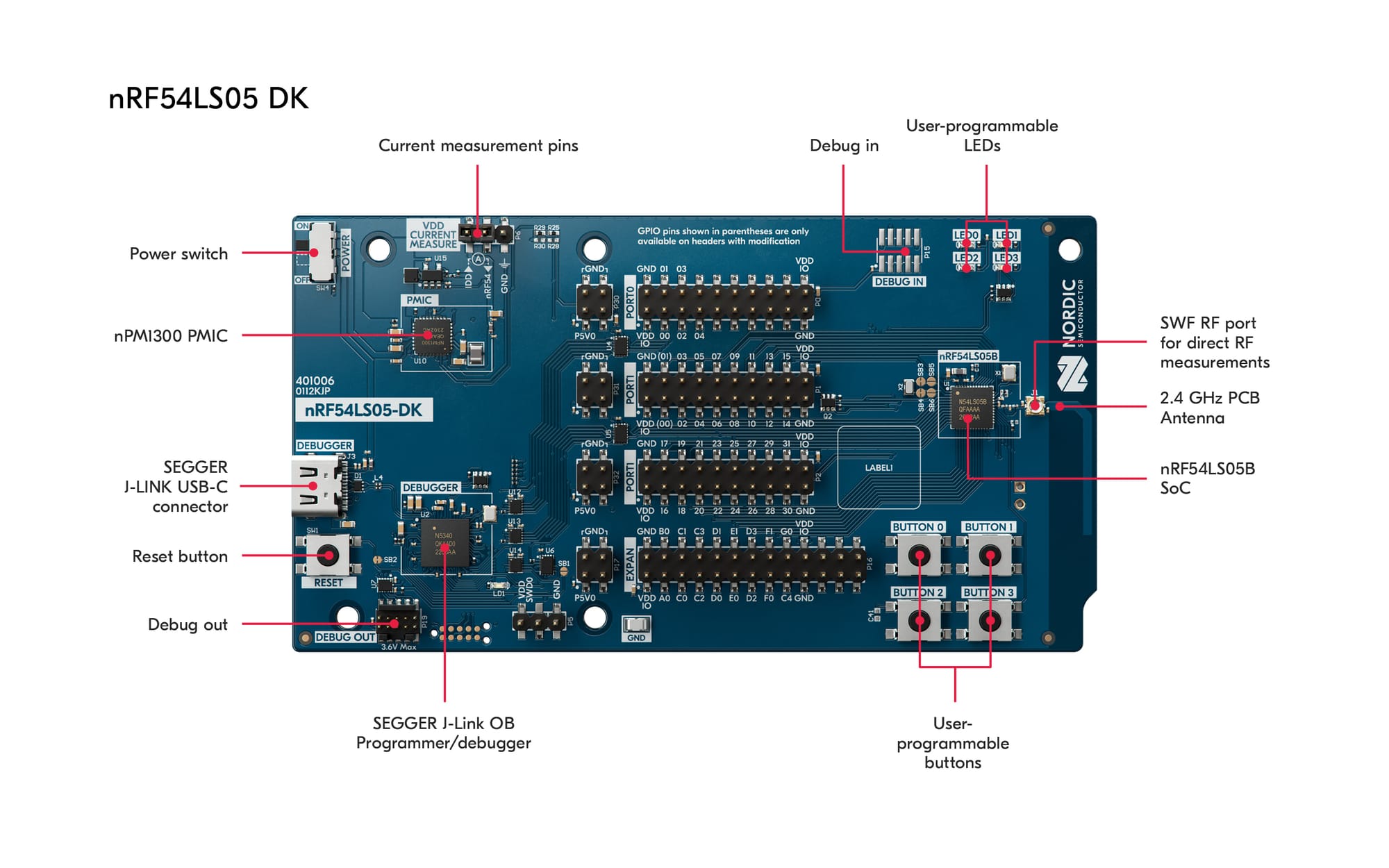
One aspect of the nRF54LS05A/B that I think deserves special attention is the nRF Connect SDK Bare Metal support. If you’re coming from the nRF5 SDK (and many developers are), you’ll appreciate having a familiar programming model on the newer hardware. The nRF54L Series — including the LS05 variants — supports nRF Connect SDK Bare Metal alongside the full Zephyr-based stack.
nRF Connect SDK Bare Metal gives you a single-threaded, event-driven programming model without the overhead of an RTOS. For the kinds of simple applications the nRF54LS05 targets — sensors, beacons, remotes — this is often all you need. It’s a smoother migration path from the nRF5 SDK, especially if your team is more comfortable with bare-metal programming.
I’ve written a comprehensive guide to nRF Connect SDK Bare Metal that covers this in detail, including the architecture differences between bare-metal and Zephyr-based development, migration strategies from the nRF5 SDK, and practical use cases. I recommend checking it out if this approach interests you.
When to Choose the nRF54LS05: A Decision Guide
Let’s step back and look at the big picture. With several SoCs in the nRF54L Series, how do you decide which one is right for your project?
Choose the nRF54LS05A/B when:
- Cost is a primary concern — your application is simple and every cent matters at scale
- You’re building simple Bluetooth LE devices — sensors, tags, beacons, remotes, or basic peripherals
- You don’t need large memory — 508 KB NVM and 64–96 KB RAM are sufficient for your firmware
- You want a Bluetooth companion chip — adding wireless capability to an existing design alongside a host MCU
- nRF Connect SDK Bare Metal is preferred — you want a simpler programming model without RTOS overhead
Consider the nRF54L15 or nRF54LM20A when:
- You need more memory — applications requiring >508 KB NVM or >96 KB RAM
- Multi-protocol support is required — simultaneously running Bluetooth LE, Matter, Thread, or Zigbee
- You need a RISC-V coprocessor — for time-critical tasks or offloading workloads (available on L15 and LM20A)
- Your design needs more GPIOs — the LS05 has fewer GPIO pins than the L15 or LM20A
- High-speed USB is needed — only available on the nRF54LM20A
Here’s a quick comparison of the key specs across the lineup:
| Feature | nRF54LS05A | nRF54LS05B | nRF54L15 | nRF54LM20A |
|---|---|---|---|---|
| NVM | 508 KB | 508 KB | 1.5 MB | 2 MB |
| RAM | 64 KB | 96 KB | 256 KB | 512 KB |
| Processor | Cortex-M33 | Cortex-M33 | Cortex-M33 + RISC-V | Cortex-M33 + RISC-V |
| USB | No | No | No | High-speed USB |
| Protocols | Bluetooth LE + proprietary | Bluetooth LE + proprietary | Bluetooth LE, Thread, Zigbee, Matter | Bluetooth LE, Thread, Zigbee, Matter |
| Target | Simple, cost-sensitive | Simple, cost-sensitive | General-purpose | Advanced/premium |
What I like about the nRF54L Series is that you don’t have to make this decision permanently — the aligned pinouts across the series give you room to scale up as your product requirements evolve.
Conclusion
In this post, we covered Nordic Semiconductor’s latest additions to the nRF54L Series — the nRF54LS05A and nRF54LS05B. These entry-level, ultra-low-power Bluetooth LE SoCs fill an important gap in the lineup for developers building simple, cost-sensitive wireless products.
Here are the key takeaways:
- The nRF54LS05A/B are entry-level Bluetooth LE SoCs optimized for sensors, tags, beacons, remotes, and PC peripherals
- They feature a 128 MHz Arm Cortex-M33 processor with 508 KB NVM and either 64 KB RAM (LS05A) or 96 KB RAM (LS05B)
- The 22nm low-leakage process delivers impressive sleep currents — as low as 0.6 µA in System OFF
- Drop-in pin-to-pin compatibility between the LS05A and LS05B, with aligned pinouts across the broader nRF54L Series to simplify hardware migration
- nRF Connect SDK Bare Metal provides a smoother migration path from the nRF5 SDK
- Baseline security helps meet current and upcoming regulatory requirements
You should now be able to evaluate whether the nRF54LS05A or nRF54LS05B is the right fit for your next project. For simple, battery-powered Bluetooth LE applications where cost matters, these SoCs give you access to the nRF54L Series’ power efficiency and modern architecture without paying for features you don’t need.


